How to Build Good Taste
Your definitive guide to shifting from trend-following to taste-building.
What does it mean to have good taste?
When I ask that question, I picture the people I admire – the ones who are so effortlessly and authentically themselves, that you can’t help but be impressed.
It’s tempting to assume they were just born this way, with good taste. But that’s rarely the case.
Because taste is something you build.
And in a world that is constantly trying to sell us more, capture our attention, and keep us chasing what’s new – building taste matters more than ever. Because it’s how you stop getting pushed around. It’s how you learn to decide.
Having taste means noticing what matters, knowing what doesn’t, and making choices that make sense for you — in your space, your style, how you spend your time, and who you surround yourself with.
After shamelessly observing those people I think have good taste, there are the four key behaviors that stand out.
I. Consume Less. Observe More.
Everyone I admire as having good taste has one thing in common: they aren’t doing T.J. Maxx runs.
It’s nearly impossible to unearth your own personal taste when you’re surrounded by shelves of gleaming new products that have been engineered to tempt you.
But casually strolling aisles, filling your cart with things professional merchandisers have told you are worth buying is the exact opposite of building good taste.
You don’t gain taste by buying – you have to build it by noticing:
Why does one woman look effortless in jeans and a sweater, while another looks slightly unfinished?
Why does one living room feel calm and another feel cold – even when the decor is similar?
Why does one city feel vibrant and another chaotic?
Most people skip this step of studying. They see, they screenshot, and then they replicate.
They comment “Link for lamp?” before noticing what about that lamp actually works.
Instead of immediately jumping to where you can buy a similar look, start by asking why you like it (or if you even do it all).
Whether it’s an outfit or a living room, when something captures your attention, try to notice things like:
Proportion
Texture
Color
Depth
Restraint
Taste begins with attention and the more you train your own eye, the less you have to rely on someone else’s.
Observation is a good place to start; but you also need better raw material.
II. Study the Old-School Influences
You will really gain clarity on how your taste has formed (or hasn’t), when you start paying attention to where your inspiration comes from.
In modern life, it’s become normal to get inspiration from people who have already curated it for us.
Think: Influencers who feed you an endless stream of new outfits (and shopping links). Content creators who publish a round-up of their favorites. Travel bloggers who hand you a complete itinerary.
But these are all just shortcuts to an attractive aesthetic. They give you a false sense of taste; a fluency for what looks good, but no real discernment.
When you only consume curated inspiration, you inherit someone else’s conclusions without understanding how they arrived there.
But if you want to build taste, you have to train yourself to go one layer deeper.
My favorite way to do this is increasing my exposure to the old-school sources of inspiration:
Go to museums and take in influential art.
Flip through architecture magazines and learn about the context.
Watch old films or read the classics and notice what’s still relevant.
Taste Old World wine that’s been made the same way for generations.
You don’t have to like everything, but this exposure sharpens your instincts. It trains you to recognize different interpretations of excellence and draw your own conclusions. The more references you have, the better your comparisons can be. And, over time, your internal standards start to form.
While observation trains your eye, exposure deepens your reference points….but neither matter if you rush the process.
III. Let it Evolve Over Time
Social media gives us a peek through the front door of everyone’s life at all times. And that constant visibility creates pressure to perfect everything immediately.
This looks like: buying a house and immediately ordering the entire vision board. Or expecting to bake market-worthy cinnamon rolls on your first try. Or one shopping spree to overhaul your wardrobe, instead of a thoughtful reinvention over time.
But you can’t rush taste.
Ina Garten worked day to night to create her charming food market shop in New England; and she wouldn’t have that effortless, unfussy air about her without it.
Julia Child’s refined flavor palette came from years of studying the art of French cooking (and eating!).
SJP’s fearless fashion sense developed because she started thrift shopping early and out of necessity.
All of these women curated their signature good taste over decades of dedication and lessons learned.
You don’t need to get a degree in design or spend a year in Paris to develop good taste, but you can learn a thing or two from the pace at which the greats do.
None of them can be who they are – or have the unique point-of-view they have – without their experience.
It’s an important lesson: taste is cumulative.
The phases you go through in life are your training ground for building taste. Traveling (or staying put), becoming a parent, and even seasons of financial hardship are all excellent teachers for maturing your perspective.
So instead of rushing to install a complete aesthetic, let things play out organically.
And on that note: It’s hard to let something mature when it feels like it’s on display. I’ve found the best ways to slow the process is to stop sharing so much online. When you aren’t curating your home or your outfit for public consumption, you give yourself space to experiment quietly, to acquire thoughtfully, and to edit slowly.
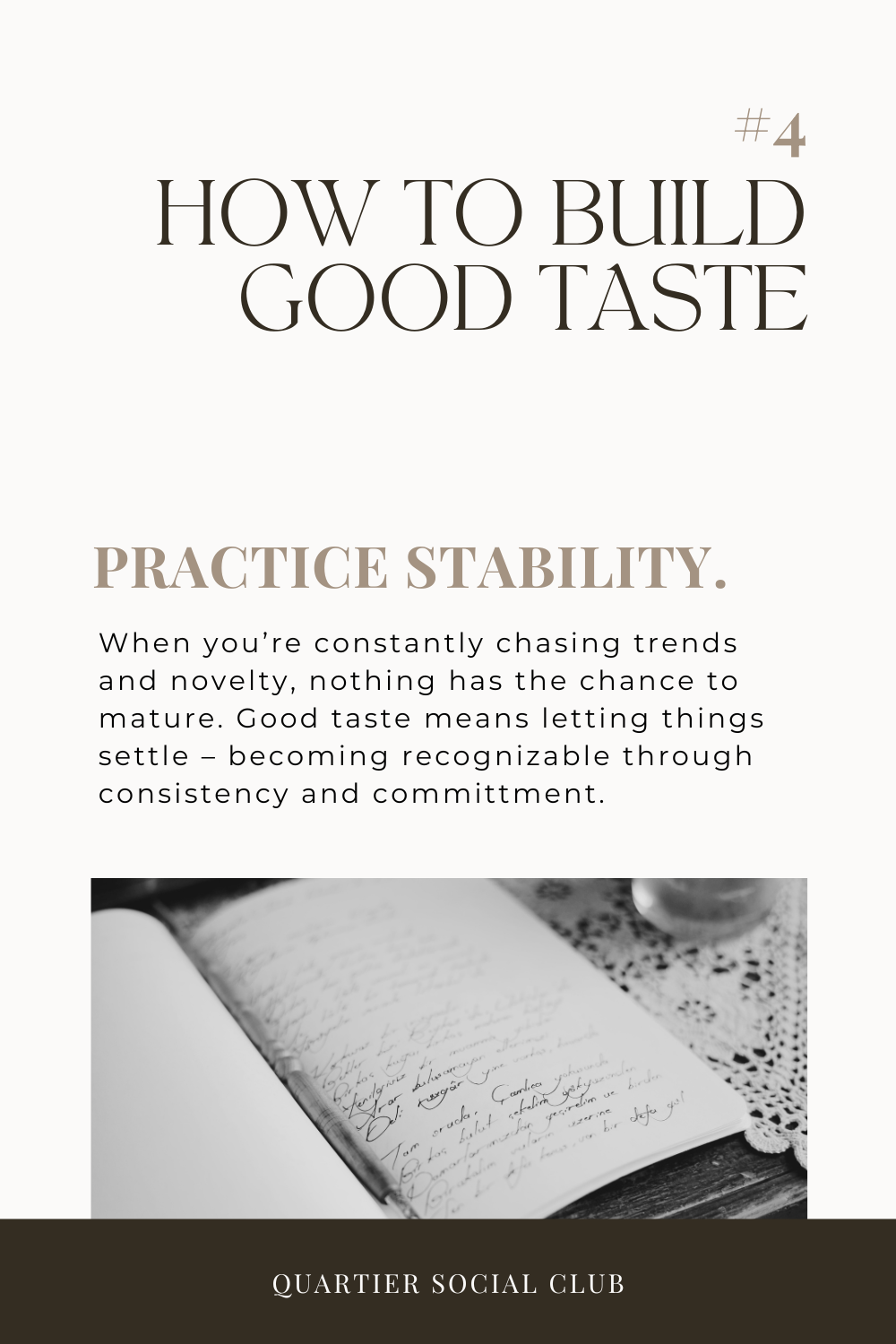
IV. Practice Stability
We often equate good taste with sharp editing – but that actually kicks in much later.
Experience and experimentation come first – you gather data and figure out what you like. But then the next step might surprise you: practicing restraint.
The most tasteful women I know aren’t constantly reinventing themselves. They are recognizable, year after year, in everything they do.
They have mastered what feels like a dying skill: settling.
Not refining, not optimizing – but just leaving it alone. Even – and especially – when it’s not perfect.
NOT And without that experience – of sitting with a style or a decision, even through the dull or cringey phases – you will never learn why something works for you (or why it doesn’t).
This applies to your closet, your home, your schedule, and even your opinions.
You won’t look trendy or cutting-edge. And the simple acts of consistency and committment will feel a little unsexy when you’re used to a culture of micro-trends and hot takes.
But learning to say “this is good enough for now” is one of the highest forms of taste.
Stepping back, one thing stands out about all of these lessons: none of it is about aesthetics.
Building taste has less to do with looking good than it does with becoming recognizable to yourself and to the world around you.
That’s why people with good taste seem so cool and magnetic. Because their persona is coherent. Their choices make sense. Everything is aligned – not because they copied a look – but because they developed their own perspective.
That’s how good taste forms – by building it, thoughtfully and over time in only the way you can.
If you loved this blog post, sign up for my newsletter so you never miss another like it!
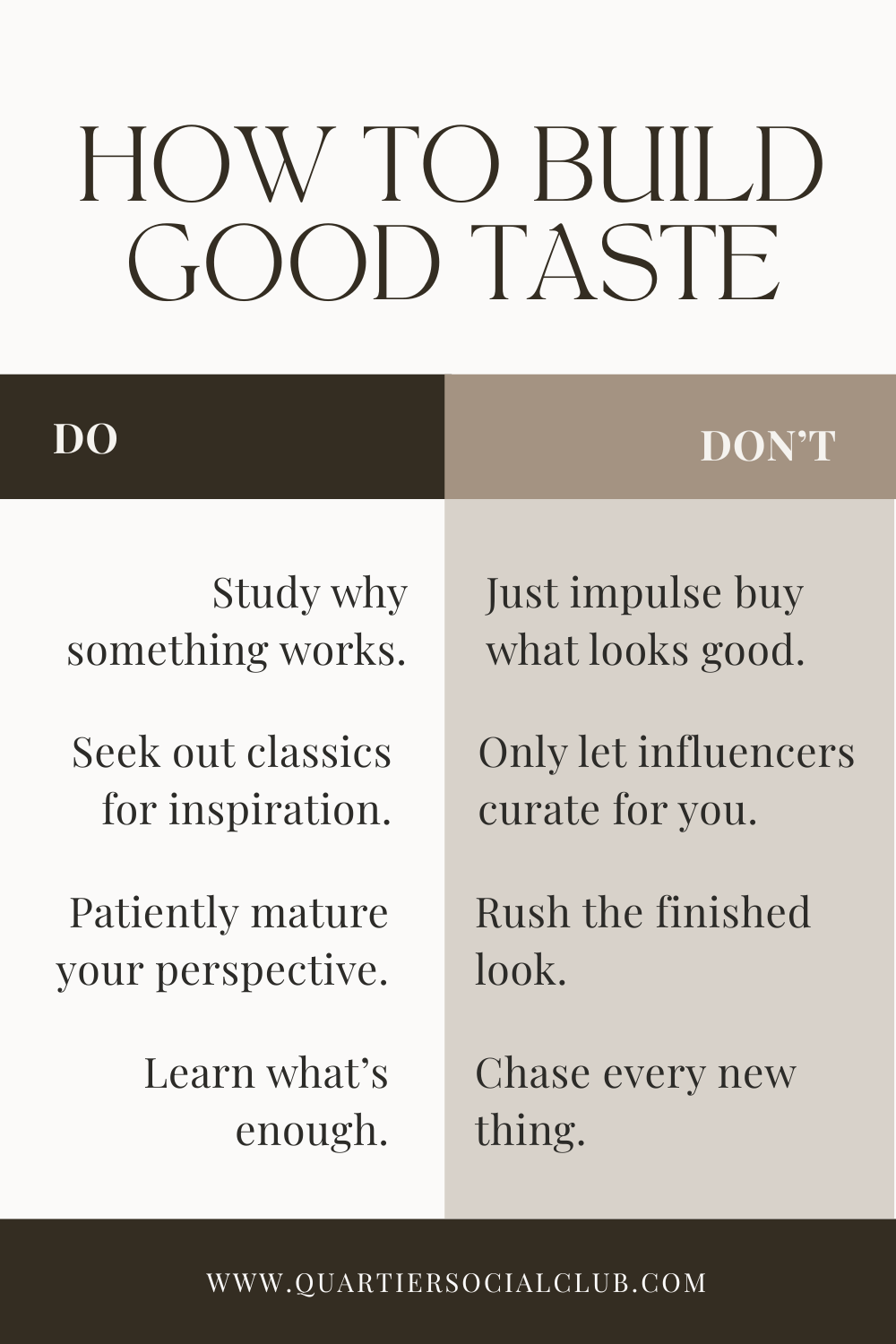
Want to know how to build taste? Click the "save" button on this photo to save these tips to your Pinterest!